

Are you looking for a meditation teacher certification program in Calgary but unsure which training provider, learning format, or certification pathway is right for you?
Choosing a meditation teacher certification program is an important decision, particularly if you plan to teach meditation professionally, integrate mindfulness into your existing career, or establish your own meditation teaching practice.
With different training formats, course durations, teaching approaches, and certification requirements, it can be challenging to determine which program offers the most meaningful educational value.
Some programs emphasize theoretical knowledge. Others focus on personal meditation practice, while certain programs provide structured opportunities to develop practical teaching skills.
But earning a certificate and becoming a confident, knowledgeable meditation teacher are not necessarily the same thing.
The right meditation teacher certification program should help you develop personal understanding, practical teaching competence, ethical awareness, and the confidence to guide others responsibly.
At the Canadian Mindfulness Research Center (CMRC) in Calgary, we offer private, personalized Mindfulness Meditation Teacher Certificate Program options that combine traditional mindfulness principles, neuroscience-informed education, practical learning, and individual mentorship.
This guide will help you compare meditation teacher certification programs in Calgary, understand what matters before enrolling, evaluate private versus group training, and make an informed investment in your future.
Considering meditation teacher certification in Calgary? Book a Free Discovery Session to explore your training options and professional goalsWhat Should You Look for in a Meditation Teacher Certification Program in Calgary?
Before choosing a meditation certification course, it is important to understand what separates a comprehensive educational program from a basic introductory course.
A meditation teacher certification program should provide more than information about meditation techniques.
It should help students develop the ability to understand, practise, explain, and responsibly facilitate meditation.
When comparing programs, focus on six essential factors.
- Instructor Experience and Teaching Background
The experience of your meditation instructor can significantly influence your learning.
Look for an instructor with an established personal meditation practice, meaningful teaching experience, and the ability to communicate mindfulness concepts clearly.
Consider whether the instructor has experience guiding individuals, teaching groups, and working with participants from different professional backgrounds.
Questions to ask:
- How long has the instructor been teaching meditation?
- What is their personal meditation background?
- Have they taught individuals and groups?
- Do they provide direct feedback?
- Can they explain both traditional mindfulness principles and relevant scientific research?
An experienced instructor should also recognize the limits of their expertise and understand when participants may need support from other qualified professionals.
- Curriculum Quality and Depth
Not all meditation certification programs cover the same subjects.
A well-designed curriculum should include mindfulness foundations, meditation practices, emotional awareness, teaching methodology, professional ethics, and practical applications.
It should also explain how students will develop the skills required to guide others.
- Practical Teaching Experience
Practical experience is especially important for aspiring meditation teachers.
Students should have opportunities to practise guiding meditation sessions, develop communication skills, and receive constructive feedback.
Learning meditation theory is valuable, but teaching requires the ability to translate that knowledge into accessible guidance.
- 4. Certification Requirements
Before enrolling, ask who issues the certificate, what training hours are required, and whether students must complete examinations or practical assessments.
A certificate issued by a training provider does not automatically represent government licensing or professional accreditation.
- Individual Attention and Mentorship
Consider whether you will receive personalized guidance throughout your learning.
Some students prefer collaborative group environments, while others benefit from private instruction that allows more individual discussion and feedback.
- Training Cost and Overall Value
The lowest-priced course is not necessarily the most suitable option.
Evaluate the quality of instruction, practical experience, individual feedback, study materials, and available support before making your decision.
- Private vs. Group Meditation Teacher Certification: Which Offers Better Value?
One of the most important decisions when selecting a meditation teacher certification program in Calgary is choosing between private and group instruction.
Both approaches have advantages, but the learning experience can be significantly different.
Comparing Private and Group Certification Programs
| Training Feature | Private One-on-One Training | Group Training |
| Instructor attention | Dedicated individual attention | Shared among participants |
| Learning pace | Personalized | Usually predetermined |
| Curriculum flexibility | Can be adapted to individual goals | Generally standardized |
| Teaching practice | Individual practice and feedback | Peer and group practice |
| Scheduling | Often more flexible | Usually fixed |
| Personal questions | More individual discussion time | Shared discussion time |
| Peer interaction | Limited unless separately arranged | Built into many programs |
| Tuition | Often higher | May be more affordable |
Why Some Students Prefer Private Meditation Teacher Training
Private certification training can be particularly valuable for individuals who want focused learning, direct mentorship, and opportunities to explore subjects in greater depth.
In a group environment, instructor time must be divided among participants. Although group interaction can be beneficial, students may have limited opportunities for individual questions or personalized feedback.
Private instruction provides a different learning experience.
Potential benefits include:
- Dedicated instructor attention throughout the learning process
- Opportunities to explore questions without group time constraints
- Direct feedback on meditation guidance and communication
- Training adapted to individual experience and understanding
- Greater flexibility to explore subjects related to professional goals
- Opportunities to identify and strengthen specific teaching skills
At CMRC, our private approach allows us to understand each student’s learning preferences, personal experience, and aspirations.
Whether you are beginning your meditation journey or already have an established personal practice, individualized training can help you focus on the areas most relevant to your development.
Private meditation teacher training is not necessarily the right choice for everyone. However, for students who value personalized mentorship and dedicated instructor attention, it can offer a meaningful educational advantage.
- How Can You Evaluate the Quality of a Certification Curriculum?
When comparing mindfulness meditation teacher certification programs in Calgary, carefully review what students actually learn.
A strong curriculum should combine personal practice, theoretical understanding, teaching methodology, and practical application.
Foundations of Mindfulness and Meditation
Students should understand present-moment awareness, attention, non-judgmental observation, acceptance, and the relationship between thoughts, emotions, and conscious awareness.
Essential Meditation Practices
A comprehensive curriculum may introduce students to:
- Breath Awareness and Conscious Breathing
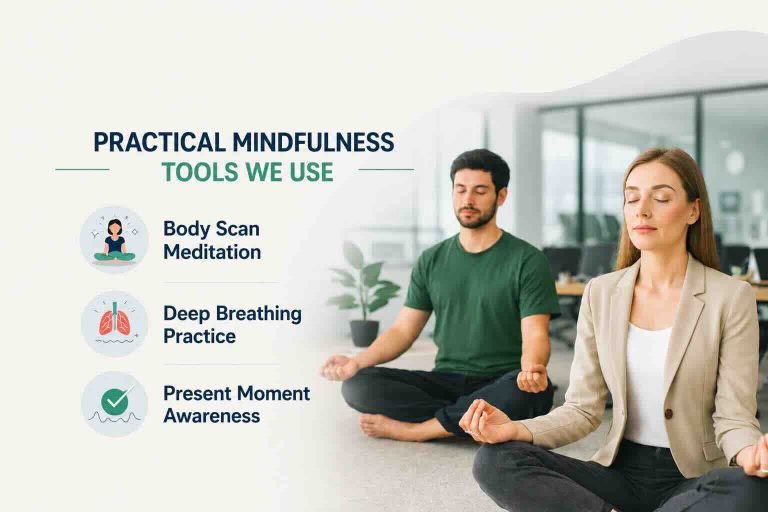
- Body Scan Meditation
- Loving-Kindness Meditation
- Self-Compassion and Compassion Practices
- Mindful Listening and Communication
- Mindful Walking and Mindful Eating
- Nature Meditation and Grounding
- Emotional Awareness and Regulation
- Everyday Mindfulness Practices
The objective should not simply be memorizing meditation techniques.
Students should learn when and how different practices may be introduced, how to communicate instructions clearly, and how to offer appropriate adaptations.
Neuroscience-Informed Mindfulness Education
Modern meditation teacher education can also explore relevant scientific understanding of attention, stress responses, emotional regulation, and neuroplasticity.
Neuroplasticity refers to the brain’s capacity to change through learning and experience.
A responsible program should explain scientific findings accurately and avoid exaggerated claims about meditation or brain transformation.
At CMRC, our educational philosophy emphasizes the connection between timeless mindfulness wisdom and neuroscience-informed understanding.
Teaching Methodology and Facilitation
If your goal is to teach meditation professionally, this component deserves particular attention.
Students should have opportunities to learn how to:
- Structure guided meditation sessions
- Introduce different techniques
- Communicate with clarity and confidence
- Use appropriate pacing and silence
- Adapt practices to participants’ needs
- Respond thoughtfully to questions
- Create supportive learning environments
- Evaluate and improve their teaching skills
When comparing programs, ask how much time is dedicated to developing practical teaching abilities—not just learning meditation concepts.
For a deeper understanding of meditation teacher training, including certification pathways, practical learning, and career opportunities, explore our Meditation Teacher Training Calgary: Complete Guide to Certification, Training & Career Opportunities.
- Why Practical Teaching Experience Matters More Than Simply Receiving a Certificate
A certificate can demonstrate that a student has completed a provider’s specified training requirements.
However, the value of the educational experience depends on what the student has actually learned and practised.
For aspiring meditation teachers, practical facilitation experience is essential.
Consider two hypothetical training experiences.
Program A: A student attends lectures, reads educational materials, and completes a written assessment.
Program B: A student studies mindfulness principle, practises meditation techniques, guides sessions, receives instructor feedback, and demonstrates practical teaching skills.
Both approaches may provide useful education.
However, for someone intending to guide meditation professionally, opportunities to practise teaching and receive feedback can be particularly valuable.
Before enrolling, ask whether the program includes supervised teaching practice, structured feedback, and assessment of facilitation skills.
Also consider whether the curriculum addresses professional ethics, confidentiality, informed choice, trauma-sensitive approaches, and appropriate professional boundaries.
Meditation teachers should never promise medical outcomes or present meditation as a substitute for appropriate healthcare.
A meaningful certification experience should support the development of responsible teaching skills, not simply the completion of instructional hours.
- How Much Does Meditation Teacher Certification Cost in Calgary?
The cost of meditation teacher certification can vary according to the provider, program duration, instructional hours, training format, and level of individual support.
Some programs offer group instruction with standardized curricula. Others provide private mentorship and customized learning pathways.
What Determines the Cost of Certification?
Several factors influence the total investment:
Training duration: Longer programs may include more instructional time, practice, and assessment.
Instructor experience: The background and expertise of the teacher may influence program pricing.
Private versus group instruction: Private education typically requires dedicated instructor time.
Practical teaching opportunities: Supervised facilitation and individualized feedback can add educational value.
Learning materials: Some programs include books, journals, recordings, or supplementary resources.
Assessment and certification: Requirements and associated costs vary by provider.
Post-training support: Some providers offer continued guidance or mentorship after program completion.
How to Compare Certification Costs
Instead of evaluating tuition alone, ask:
- What is the total cost, including applicable taxes?
- How many hours of direct instructor-led training are included?
- What learning materials are provided?
- Is practical teaching experience included?
- Are assessments and certification fees included?
- Will I receive personalized feedback?
- Are installment payment arrangements available?
- What support is available after completion?
A higher-priced program is not automatically better, and a lower-priced program is not necessarily inadequate.
The most important consideration is whether the training provides appropriate value for your learning goals.
CMRC Private Certification Training Options
At the Canadian Mindfulness Research Center, private training options can be discussed according to individual learning objectives, preferred duration, and professional aspirations.
During a complimentary discovery session, prospective students can review available training pathways, instructional hours, scheduling, certification requirements, and tuition.
This allows you to understand the educational commitment before making an enrollment decision.
- How to Verify a Meditation Teacher Certification Before Enrolling
One of the most important questions prospective students ask is whether a meditation teacher certificate is recognized.
The answer depends on the training provider, certificate issuer, intended professional use, and requirements of any relevant employer or professional organization.
Meditation teaching does not have one universally recognized certification system that automatically applies to every training provider and professional setting.
Therefore, it is important to understand what a particular credential represents.
Questions About Certification Recognition
Ask the training provider:
- Who issues the certificate?
- What are the completion requirements?
- Are practical teaching skills assessed?
- Does the certificate represent course completion or an externally accredited qualification?
- Is the program recognized by any professional organizations?
- Are there continuing education requirements?
- Will the credential meet the expectations of organizations where I intend to teach?
Do not assume that completing a certificate program automatically qualifies you to provide psychotherapy, clinical treatment, or other regulated healthcare services.
Choose a certification program based on transparent educational standards and suitability for your goals, rather than relying only on the word “certified.”
You can learn more below
- What Makes CMRC’s Private Meditation Teacher Certificate Program Different?
The Canadian Mindfulness Research Center (CMRC) provides private mindfulness and meditation teacher education in Calgary, Alberta.
Founded by Sanjeev Kumar, an author and mindfulness and meditation teacher with over 13 years of teaching experience, CMRC emphasizes personalized mentorship, practical learning, and the integration of traditional mindfulness principles with neuroscience-informed education.
Our approach is designed for individuals seeking a focused educational experience rather than a one-size-fits-all learning environment.
Personalized One-on-One Learning
Students receive dedicated instructor attention, allowing them to explore questions and concepts according to their background and learning needs.
Learning Through Experience
Our educational approach combines mindfulness theory with direct meditation experience and practical application.
Individual Teaching Development
Students interested in becoming meditation teachers can explore session development, meditation guidance, communication skills, and practical teaching considerations.
Traditional Wisdom and Neuroscience
Our approach connects timeless mindfulness principles with relevant scientific understanding of attention, stress, learning, and emotional awareness.
Everyday Life and Nature-Based Mindfulness
Mindfulness is explored not only as a seated meditation practice but also through walking, listening, eating, nature awareness, and everyday activities.
Professional Development Guidance
CMRC also offers guidance for individuals interested in developing their own meditation teaching practice or integrating mindfulness into professional settings.
The specific training structure and available support can be discussed during a complimentary discovery session.
Our objective is to help students develop meaningful understanding and practical competence through personalized education—not simply complete a course for the sake of receiving a certificate.
Are you considering becoming a certified meditation teacher in Calgary? Explore our Mindfulness Meditation Teacher Certificate Program at the Canadian Mindfulness Research Center (CMRC), where personalized one-on-one training combines practical meditation teaching, neuroscience-informed learning, and professional mentorship.
- Which Meditation Teacher Certification Program Is Right for Your Goals?
Different students pursue certification for different reasons.
Understanding your primary motivation can help you select an appropriate learning pathway.
If You Are New to Meditation
Choose a program that explains foundational concepts clearly and provides sufficient time to develop your personal practice.
Look for patient instruction, accessible teaching, and opportunities to ask questions.
If You Already Have Meditation Experience
Consider a program that allows you to explore teaching methodology, deeper mindfulness concepts, communication, and practical facilitation.
Individualized instruction may help you build on your existing knowledge.
If You Want to Become a Professional Meditation Teacher
Prioritize practical teaching experience, ethics, structured learning, feedback, and clear certification requirements.
If You Are a Wellness Professional or Educator
Look for training that explores how mindfulness education may complement your existing work while respecting professional boundaries and applicable requirements.
If You Want to Start Your Own Meditation Business
Consider whether the provider offers guidance on developing meditation sessions, identifying audiences, structuring programs, and understanding professional responsibilities.
Business development also requires independent planning, marketing, and appropriate administrative arrangements.
Certification alone does not guarantee clients, employment, or business success.
If You Want Personal Growth
You may prefer a program that emphasizes self-awareness, emotional understanding, personal practice, and everyday mindfulness.
Not every student needs to pursue professional teaching.
The best certification program is the one that aligns with what you genuinely want to learn and accomplish.
- Red Flags to Watch for When Choosing a Certification Program
Before investing in meditation teacher training, be cautious of programs that do not provide clear information about their educational structure or credentials.
Potential warning signs include:
Unclear certification requirements: The provider cannot explain how students qualify for their certificate.
Limited curriculum information: There is little detail about the subjects or teaching skills covered.
No meaningful practical teaching opportunities: Students receive minimal opportunity to practise facilitating meditation despite the program being marketed as teacher preparation.
Unclear tuition: Additional costs or assessment requirements are not explained before enrollment.
Lack of professional boundaries: The program does not address ethics, participant safety, or the limits of meditation teaching.
Pressure to enroll immediately: Prospective students are discouraged from asking questions or reviewing course details.
A credible training provider should welcome informed questions and explain what students can reasonably expect.
- Your Meditation Teacher Certification Decision Checklist
Use this checklist when comparing meditation teacher certification programs in Calgary.
- The instructor has relevant meditation teaching experience.
- The curriculum includes both theory and practical learning.
- The program offers meaningful teaching practice.
- I understand who issues the certificate.
- Assessment and completion requirements are clear.
- The learning format suits my needs.
- The total tuition and additional costs are explained.
- Professional ethics and participant safety are addressed.
- The program aligns with my personal or professional goals.
- I understand what support is available during and after training.
If several important questions remain unanswered, request more information before committing.
A thoughtful decision today can help you choose a training experience that supports your long-term development.
Frequently Asked Questions About Meditation Teacher Certification in Calgary
- How do I choose the best meditation teacher certification program in Calgary?
Compare instructor experience, curriculum depth, practical teaching opportunities, certification requirements, training format, costs, and individual support. The most suitable program depends on your experience and professional goals.
- Is private meditation teacher certification worth the additional cost?
Private training may be valuable for students who prefer dedicated instructor attention, personalized learning, flexible pacing, and direct teaching feedback. However, group training may be more suitable for those who value peer interaction or a lower tuition cost.
- How do I know whether a meditation teacher certificate is recognized?
Ask who issues the certificate, whether the program has external accreditation, and what requirements are involved. Verify whether the credential meets the expectations of your intended employer, professional organization, or teaching environment.
- Do I need previous meditation experience to enroll?
Requirements vary by program. Some courses accept beginners, while others expect an established meditation practice. At CMRC, prospective students can discuss their experience during a complimentary discovery session.
- How much does meditation teacher certification cost in Calgary?
Costs vary according to instructional hours, training format, curriculum, assessments, and support. Request a complete breakdown of tuition and included services before enrolling.
- Is online or in-person meditation teacher training better?
Both formats can provide valuable education. In-person training may appeal to students who prefer direct physical interaction, while online training can offer convenience and accessibility. Evaluate the teaching methods and practical experience included in either format.
- Can I become a meditation teacher after completing certification?
Completing appropriate training may help you develop the skills to offer meditation education. However, a certificate does not automatically provide professional licensing, guarantee employment, or authorize regulated healthcare practice.
- Does CMRC offer private meditation teacher certification in Calgary?
Yes. CMRC offers private Mindfulness Meditation Teacher Certificate Program options with personalized instruction, practical learning, and neuroscience-informed mindfulness education.
- What should I ask during a meditation teacher certification discovery session?
Ask about the curriculum, instructional hours, teaching practice, certification process, tuition, scheduling, instructor experience, and available mentorship.
- Can meditation teacher certification help me start a business?
Training may help develop your knowledge and teaching confidence. Establishing a successful meditation business also requires planning, marketing, ethical practice, appropriate insurance, and compliance with relevant requirements.
Final Thoughts: Choosing the Right Meditation Teacher Certification in Calgary
Choosing a meditation teacher certification program is not simply about finding the shortest course, lowest tuition, or most attractive certificate.
It is about finding an educational experience that supports your personal understanding, develops practical teaching competence, and aligns with your future aspirations.
Before enrolling, compare the quality of instruction, learning format, certification requirements, practical teaching opportunities, and overall educational value.
For individuals who prefer personalized attention and direct mentorship, private meditation teacher training can offer a valuable alternative to traditional group programs.
At the Canadian Mindfulness Research Center in Calgary, our private educational approach brings together mindfulness principles, neuroscience-informed understanding, practical meditation experience, and individual guidance.
Whether you are exploring meditation teaching as a new career, expanding your professional skills, or deepening your personal practice, we welcome the opportunity to discuss your goals.
Ready to Explore Meditation Teacher Certification in Calgary?
Book a Free Discovery Session With CMRC
During your complimentary conversation, we can:
- Discuss your personal and professional aspirations.
- Explore available private certification training options.
- Explain the curriculum and teaching approach.
- Review training duration, scheduling, and tuition.
- Discuss certification requirements and available mentorship.
- Help you determine whether our program is an appropriate fit.
You do not need to make an enrollment decision before understanding your options. Begin with a conversation about your goals.
Book Your Free Discovery Session Today
Canadian Mindfulness Research Center (CMRC)
Calgary, Alberta, Canada
Website: https://santeaching.com
Phone: 403-466-3161
Where Neuroscience Meets Timeless Wisdom.