

For many people, meditation begins as a personal practice—a way to slow down, become more aware, and create some space from the constant movement of thoughts and daily responsibilities.
Over time, that personal practice can develop into something deeper. You may become curious about why certain practices work for you, how different approaches to meditation are taught, or how you might confidently guide another person.
If you are considering meditation teacher training in Calgary, choosing a program involves more than comparing course hours or receiving a certificate. The quality of your learning experience, the depth of your personal practice, opportunities to teach, and the guidance you receive along the way can all matter.
This guide explains what to look for in meditation teacher training, what you may learn, the differences between private and group instruction, and how training can support both personal development and future teaching goals.
What Does Meditation Teacher Training Actually Involve?
Learning to meditate and learning to teach meditation are two different experiences.
As a practitioner, your attention is primarily on your own experience. As a teacher, you also need to consider the person or group in front of you.
How do you explain a practice clearly? How much guidance should you provide? When should you allow silence? How do you work with someone who finds it difficult to concentrate? How do you respond when a participant asks a question outside your area of expertise?
A well-developed teacher training program should therefore go beyond meditation scripts and techniques.
It can help you develop three areas simultaneously: your personal practice, your understanding of mindfulness and meditation, and your ability to guide others.
This combination of theory, experience and practical teaching can provide a stronger foundation than learning techniques in isolation.
Who Might Benefit From Meditation Teacher Training?
Not everyone who enters teacher training intends to become a full-time meditation teacher.
Some people want to deepen a practice they have maintained for years. Others want to integrate mindfulness into work they already do.
Training may be relevant for aspiring meditation teachers, yoga instructors, coaches, educators, wellness professionals, facilitators and people interested in bringing mindfulness into workplace or community settings.
It may also appeal to someone who simply wants a more structured and in-depth understanding of meditation.
Your reason for training matters because it can influence the type of program that is most appropriate for you.
Someone interested primarily in personal transformation may have different learning priorities from someone who wants to facilitate workplace mindfulness sessions or eventually develop a private meditation practice.
Training and Certification Are Not Quite the Same Thing
The words training and certification are frequently used together, but they are worth distinguishing.
Meditation teacher training is the educational process: studying principles, developing a personal practice, exploring different meditation methods, practicing facilitation and receiving feedback.
Certification generally refers to the certificate awarded by a particular training provider after its completion requirements have been met.
When considering meditation teacher certification in Calgary, it is therefore useful to look beyond the certificate itself.
Ask what you will actually be able to understand and demonstrate when the program is finished.
Will you have opportunities to guide meditation rather than only study it? Will you receive feedback? Will the program address professional boundaries and ethical considerations? Will you understand how to adapt a practice for different people?
The learning behind the certificate is ultimately what develops your capability as a teacher.
Building a Strong Foundation in Mindfulness
Before learning how to guide others, it helps to understand what you are guiding.
Mindfulness involves intentionally bringing awareness to present experience with greater openness and less automatic judgment.
That sounds straightforward, but experiencing it consistently can take practice.
Students can learn to observe thoughts without automatically following every thought, recognize physical sensations, notice emotional responses and become more aware of habitual reactions.
For a future teacher, these foundations are important.
It is difficult to authentically explain awareness, patience or non-judgment simply by memorizing definitions. Personal practice gives these concepts meaning.
Working With the Breath and Body
Breath awareness is one of the most accessible ways to begin developing attention.
Rather than trying to force the mind to become completely quiet, a practitioner can use the natural movement of breathing as a point of attention. When attention wanders—as it naturally does—the practice is to recognize that movement and return.
That simple process can reveal a great deal about attention and habitual thinking.
Body-based practices can deepen this awareness.
In a Body Scan Meditation, for example, attention gradually moves through different areas of the body while noticing sensations without needing to immediately change them.
Future teachers should not only experience these practices themselves. They should learn how to guide them clearly, how to pace their instructions and how to leave enough silence for participants to have their own experience.
Compassion, Loving-Kindness and Self-Compassion
Meditation is not simply an exercise in concentration.
Compassion-oriented practices introduce another dimension: how we relate to ourselves and other people.
Loving-Kindness Meditation, compassion practices and self-compassion exercises can encourage participants to explore qualities such as patience, kindness and understanding.
For a teacher, this is also reflected in the way a session is facilitated.
A meditation teacher does not need to demand that every participant have the same experience. Some people settle into a practice quickly; others may encounter distraction, restlessness or uncertainty.
Learning to meet those differences without unnecessary judgment is itself part of mindful teaching.
Understanding Thoughts, Emotions and Automatic Reactions
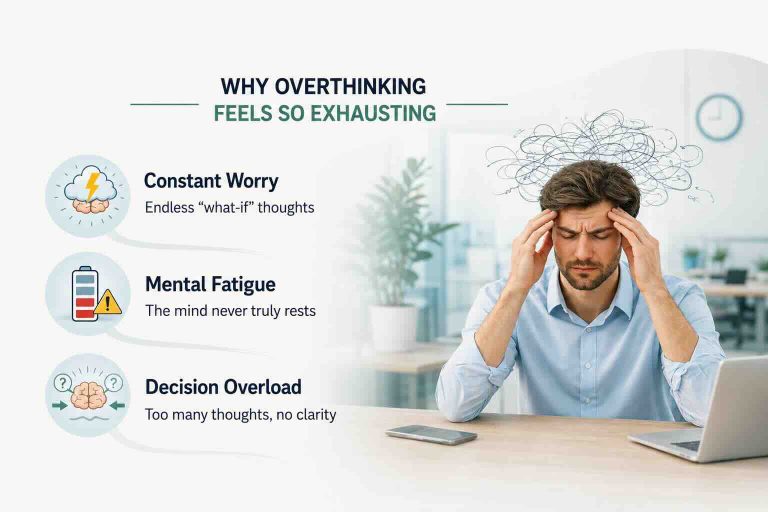
Many people become interested in meditation because their minds feel constantly busy.
They may experience everyday stress, persistent overthinking or difficulty switching off after work.
Meditation should not be presented as a promise that thoughts will disappear.
A more practical approach is learning to notice thoughts without automatically becoming involved in each one.
The same principle can apply to emotions.
Suppose someone receives an upsetting email. The automatic response might be to reply immediately while frustrated. Mindful awareness may allow that person to notice the emotional reaction, recognize tension in the body, pause and decide how to respond.
The emotion has not necessarily disappeared. What has changed is the awareness surrounding it.
Understanding this difference between automatic reaction and conscious response is valuable both personally and when teaching mindfulness to others.
What Neuroscience Can—and Cannot—Tell Us About Meditation
The brain and nervous system are capable of adapting in response to experience, a broad capacity known as neuroplasticity.
Meditation and mindfulness researchers have investigated how repeated practice may relate to attention, emotional processing, self-awareness and changes in brain structure and function.
Research in this area is promising, but it should be communicated carefully. Studies vary considerably in design, meditation method, duration and participant population, and researchers continue to examine how robust particular findings are.
For a meditation student, there is a useful practical principle without making exaggerated claims about “rewiring the brain”: what we repeatedly practice can influence learned patterns of attention and behaviour.
A teacher who understands both the possibilities and limitations of the science can discuss meditation more responsibly.
Mindful Listening and Conscious Communication
Teaching meditation requires listening as much as speaking.
Mindful listening means giving another person genuine attention rather than spending the conversation preparing your next response.
Teacher training can provide opportunities to practice listening, asking appropriate questions, communicating instructions clearly and becoming comfortable with silence.
It should also help future teachers understand boundaries.
Meditation teachers can provide meditation and mindfulness education within their competence. They should not diagnose medical or psychological conditions or present themselves as providing regulated professional services unless they hold the appropriate qualifications.
Knowing when another type of professional support may be appropriate is part of responsible teaching.
Meditation Doesn’t Have to Stay on the Cushion
Formal seated practice is valuable, but mindfulness becomes especially meaningful when it begins to enter ordinary life.
Walking can become an awareness practice.
Eating can become an opportunity to notice taste, texture and habitual behaviour.
A conversation can become an opportunity to practice listening.
A difficult moment can become an opportunity to observe an emotional reaction before responding.
Even everyday activities such as showering, drinking tea or moving between meetings can provide opportunities to return attention to what is happening now.
A comprehensive training program can help future teachers understand how to translate meditation principles into everyday experiences rather than treating mindfulness as something practiced only during a scheduled session.
Learning From Nature
Calgary also provides access to natural environments that can support a different kind of mindfulness practice.
Nature meditation might involve sitting quietly and observing the environment without needing to label everything. Mindful walking can bring attention to movement, contact with the ground, sounds and changing sensations.
A sensory practice may involve noticing wind, temperature, birds, water, trees or periods of silence.
These experiences can help students discover that awareness does not depend on a particular room, posture or meditation cushion.
Nature can become another environment in which presence is practiced.
Moving From Practicing Meditation to Teaching It
One of the most important parts of teacher development is actually practicing how to teach.
Knowing a meditation personally does not automatically mean you can communicate it effectively to someone else.
Students can benefit from learning how to introduce a meditation, explain its purpose without overexplaining, guide attention, use silence appropriately and conclude a practice without abruptly interrupting the experience.
Teaching practice can also explore how to work with beginners, respond to questions and structure an individual session or group class.
Feedback is especially useful here.
A student may discover, for example, that they speak too quickly while guiding meditation, provide too many instructions, leave too little silence or assume that participants understand terminology that is unfamiliar to them.
These are skills that improve through practice.
Private vs. Group Teacher Training
Both private and group learning have advantages.
Group training provides an opportunity to practice alongside other students, hear different perspectives and experience a sense of community.
Private training offers something different: individual attention and greater ability to adapt the learning process to one person’s goals.
In one-to-one training, there may be more time to ask detailed questions, explore particular subjects, receive direct feedback and adjust the pace of learning.
For example, someone hoping to introduce mindfulness into corporate environments may want to spend additional time learning how to structure shorter workplace practices. Someone interested in private teaching may want more practice conducting individual sessions.
A student with substantial meditation experience may also progress differently from someone establishing a consistent practice for the first time.
Neither private nor group training is automatically superior. The better choice depends on how you learn and what you hope to do with the training.
In-Person or Online Training?
For people living in Calgary, in-person teacher training offers direct interaction with the instructor and the opportunity to practice facilitation face-to-face.
Some students value being physically present because subtle elements of communication, pacing and group interaction can be easier to observe.
Online learning offers flexibility and makes training accessible to people outside the city or those whose schedules make regular travel difficult.
When both formats are available, the decision should be based on your learning preferences, schedule and goals rather than assuming one format is right for everyone.
How Long Should Meditation Teacher Training Take?
There is no universal number of hours that automatically makes someone an effective meditation teacher.
Training programs vary considerably in length, depth and structure.
A shorter program may introduce important foundations, while a longer program can create more time for personal practice, reflection, teaching experience and feedback.
Instead of evaluating a course only by its number of hours, consider what happens during those hours.
A useful question is:
How much opportunity will I have to practice, teach, ask questions, receive feedback and integrate what I am learning?
That can tell you more about the educational experience than duration alone.
How to Choose Meditation Teacher Training in Calgary
If you are comparing programs, begin with your own goal.
Are you primarily interested in personal development? Do you want to teach individuals? Are you considering group classes? Would you like to integrate mindfulness into an existing profession?
Once that is clear, investigate the program itself.
Look at the instructor’s experience and approach. Review the curriculum. Find out whether the course includes actual teaching practice and feedback. Ask how much attention is given to ethics and professional boundaries.
You may also want to understand whether the course is primarily theoretical or experiential.
Meditation is an experiential practice. Reading and theory can provide valuable understanding, but students also need opportunities to practice what they are learning.
A complimentary conversation with the instructor before enrolling can be useful because it gives both sides an opportunity to determine whether the program and learning approach are a good fit.
A Calgary-Based Approach at the Canadian Mindfulness Research Center
The Canadian Mindfulness Research Center (CMRC) offers mindfulness and meditation education in Calgary for individuals, professionals and organizations.
Our approach combines theoretical understanding with experiential practice and real-world application.
Within teacher training, this means learning about mindfulness while also practicing meditation, exploring awareness in everyday situations and developing the skills needed to guide others.
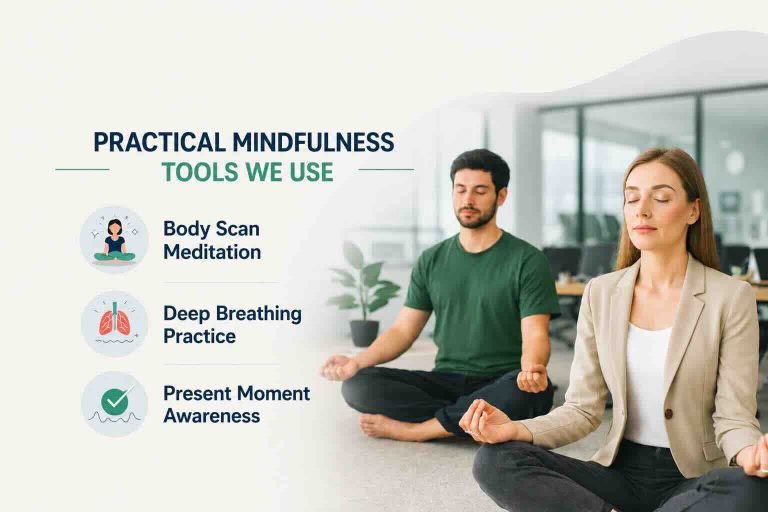
Depending on the training pathway, areas of study may include breath awareness, Body Scan Meditation, compassion and self-compassion, mindful listening, emotional awareness, everyday mindfulness, nature-based practices and teaching methodology.
Students interested in the teaching pathway can explore the Mindfulness Meditation Teacher Certificate Program to understand the available training options and determine whether private training aligns with their goals.
Where Can Teacher Training Lead?
There is no single path after completing meditation training.
Some people want to guide private meditation sessions or community classes. Others want to incorporate mindfulness into an existing area of work.
Depending on a person’s experience, qualifications and professional scope, mindfulness education may have applications in workplace wellness, education, community programs, retreats, private practice or online instruction.
Training can provide a foundation, but becoming an effective teacher remains an ongoing process.
Continuing your own practice, learning from experience, maintaining appropriate boundaries and remaining open to further education are all part of that development.
Is Meditation Teacher Training Right for You?
A useful place to begin is not by asking, How quickly can I become certified?
Instead, ask:
Why do I want to learn this deeply?
Perhaps you want to help other people discover meditation. Perhaps mindfulness complements the work you already do. Or perhaps you simply feel ready to deepen your own understanding.
There is no need for everyone to have the same reason.
What matters is finding training that gives you enough space to learn, practice, question, experience and gradually develop confidence.
If you are exploring meditation teacher training in Calgary, take time to speak with the instructor, understand the curriculum and consider whether the teaching approach fits the way you want to learn.
At the Canadian Mindfulness Research Center, prospective students can learn more about the Mindfulness Meditation Teacher Certificate Program or begin with a complimentary discovery session to discuss their goals and determine which training pathway may be appropriate.
Frequently Asked Questions
- How do I become a meditation teacher in Calgary?
Start by developing a consistent personal practice and then look for structured teacher training that includes both theoretical understanding and practical facilitation experience. Compare programs based on curriculum, instructor experience, teaching practice, feedback, ethics and the requirements for completing the program rather than choosing on the basis of a certificate alone.
- Do I need certification to teach meditation in Canada?
The answer depends partly on what services you intend to provide and the setting in which you work. A certificate issued by a private meditation training provider should not be confused with a government licence or a regulated healthcare credential. If you intend to combine meditation with a regulated profession, you should also follow the requirements and standards applicable to that profession.
- How long does it take to become a meditation teacher?
There is no universal training duration. Programs range from shorter foundational courses to training extending over several months or longer. Consider not only the total hours but also how much personal practice, teaching experience, individual feedback and integration the program provides.
- Can I complete meditation teacher training online?
Some meditation teacher training programs are available online, while others are offered in person or through a combination of formats. Online learning can provide flexibility, while in-person instruction can offer direct interaction and immediate practice with an instructor. The most suitable format depends on your learning preferences and goals.
Ready to Begin Your Meditation Teacher Journey?
Deepen your practice, build confidence, and learn to guide others through personalized meditation teacher training in Calgary.